Episode 2 · October 25, 2026
From DP World to Ras Al Khaimah: Sagarika Sahoo on Building Commerce Connect
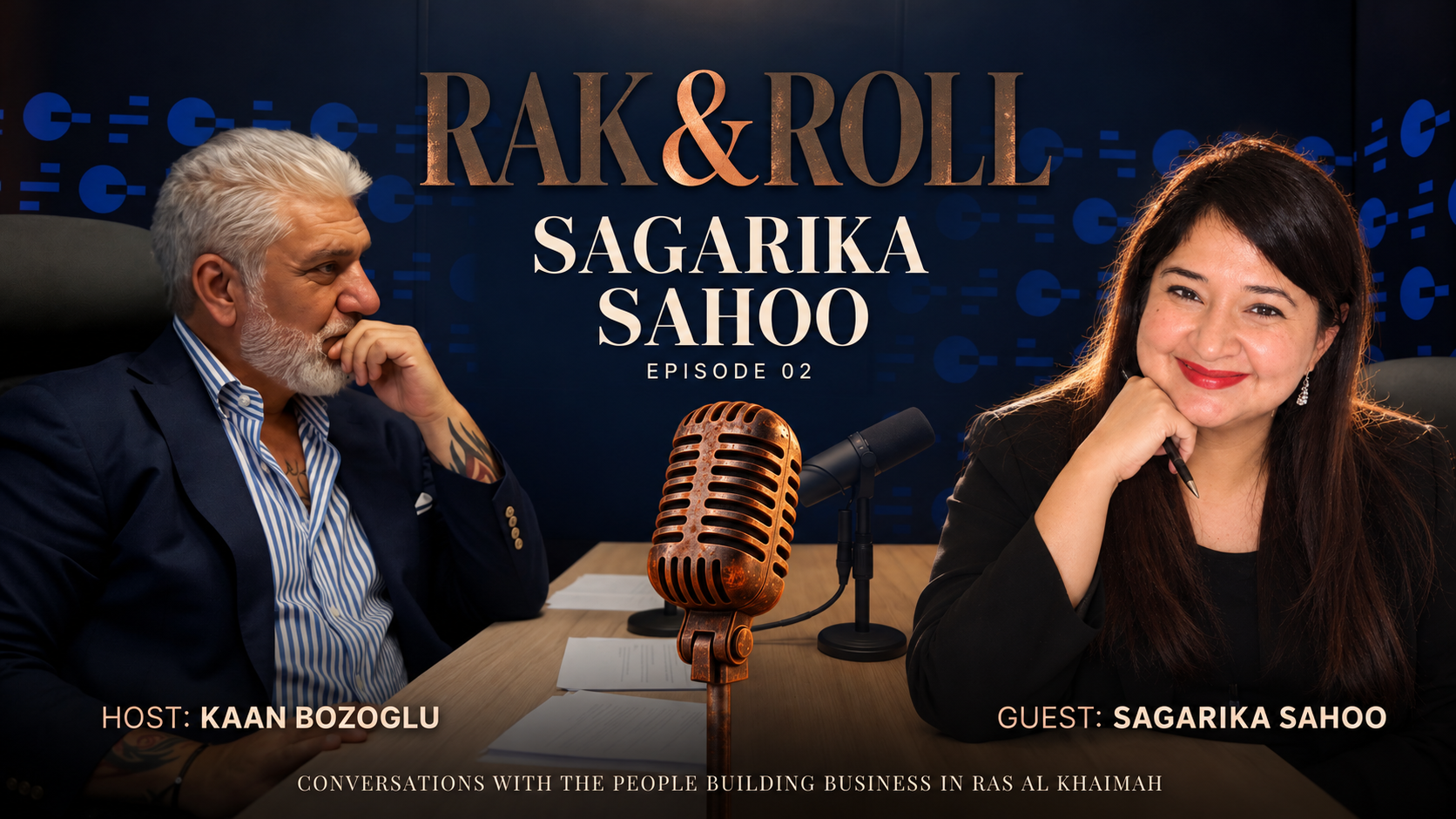
Sagarika Sahoo joins Kaan Bozoglu to discuss UAE market entry, cash flow, client relationships and the move from Dubai to Ras Al Khaimah. Watch the 35-minute YouTube excerpt or listen to the complete conversation on Spotify.

The full conversation
Listen on Spotify.
Hear the complete conversation, then explore the episode notes and transcript below.
Watch the episode
Episode overview
The conversation
Sagarika Sahoo, Managing Director of Commerce Connect, helps companies think through how to enter a new market. In Episode 2 of RAK & ROLL, she joins Kaan Bozoglu at Innovation City in Ras Al Khaimah to talk about the work behind that advice and the life she has built alongside it.
She traces her journey from Pune to Dubai, from feasibility studies at DP World and work with the DIFC Authority to starting Commerce Connect in 2014. Her account of building the business includes cash-flow pressure, difficult relationships, referrals and knowing when a client's budget means saying no.
One example brings her approach into focus. A Canadian construction-sector client wanted a large event to enter the region. Sagarika explains why she recommended separate B2B meetings with potential buyers instead, and how that approach helped the client enter the UAE, Qatar and Saudi Arabia.
The conversation also explores her move to Ras Al Khaimah, a sabbatical, continued education and a different relationship with work. She talks about patience in business, a community willing to share its experience, mentoring women and how her definition of success has changed.
- Business
- Commerce Connect
- Location
- Dubai, Dubai, United Arab Emirates
- Official website
- Visit business website
Key takeaways
What stands out
- Start with what the new market needs, then decide what to offer and how to enter.
- Choose marketing activity around the buyers you need to reach and the result you want.
- Plan cash flow for the possibility that payments arrive later than agreed.
- Say no when the budget or scope prevents you from doing the job properly.
- Build trust through honest conversations about what you can deliver.
- Give existing clients a reason to recommend you to others.
- Allow time for relationships to develop in Ras Al Khaimah.
- Reconsider what success means as your priorities change.
In this episode
What we discussed
Growing up in Pune and studying advertising, PR and foreign trade.
Moving to Dubai and working on international feasibility studies at DP World.
The DIFC years, entrepreneurship education and founding Commerce Connect.
Responding to what clients need rather than holding onto a fixed offer.
Cash flow, delayed payments and learning to read people.
Integrity, authenticity and the pressures of expat life.
Women's business experiences and mentoring across regions.
Moving from Dubai to Ras Al Khaimah and taking a sabbatical.
The meaning of Sagarika's name and the story behind Commerce Connect.
Helping a Canadian client enter GCC markets through direct B2B meetings.
Saying no, protecting the quality of work and growing through referrals.
Business opportunities and having more than one source of income.
Patience, community and sharing knowledge in Ras Al Khaimah.
Changing definitions of success, a planned travel platform and mentoring women.
Marketing
Marketing discussion
Sagarika's Canadian client example starts with a question: what should the marketing achieve? The client wanted a large event to make an impression in the market. She recommended a series of separate B2B meetings with major construction companies because those were the buyers the client needed to reach.
Her wider approach to market entry begins with demand. Before choosing an event, a distributor, a wholesale arrangement or a company setup, she asks what the market needs and how the business can meet it.
She also describes referrals and repeat business as important sources of growth. In her experience, honesty about delivery, budgets and limits helps build the trust behind those recommendations.
Local context
Ras Al Khaimah and the UAE
Sagarika describes Dubai as a market she knew well through her government-sector work and business relationships. Her move to Ras Al Khaimah was a personal choice about pace and quality of life, while her team continued working in Dubai.
In RAK, she has found a community where people share experience and advice. She also says business decisions can take longer, making patience part of building relationships here. These are her experiences of the two places, rather than a claim that either market works the same way for everyone.
The conversation was recorded at Innovation City, Ras Al Khaimah. Sagarika discusses her work with the Rotary Club of Ras Al Khaimah, her interest in mentoring women and a travel platform she was developing at the time of recording.
Key moments
Chapters
- Welcome and introduction
- 0:52 Pune, education and her first events
- 2:23 Coming to Dubai and feasibility studies at DP World
- 4:06 The DIFC years and founding Commerce Connect
- 5:35 Dubai vs RAK and responding to client needs
- 7:09 The hardest challenges: cash flow and people
- 9:03 Integrity is a value system, not a nationality
- 10:52 Visas, survival mode and reading people
- 12:37 India vs the UAE: a fair chance
- 14:46 Women in leadership across regions
- 17:55 Why she moved to Ras Al Khaimah
- 19:38 A sabbatical, Stanford and no more alarms
- 22:04 Life in RAK: community, pace and barbecues
- 24:16 Daughter of the ocean and Commerce Connect
- 25:57 Helping companies and governments enter the UAE
- 27:41 The Canadian client: B2B meetings over events
- 29:35 Authenticity, saying no and referrals
- 31:49 Opportunities, gut feel and an insurance business
- 33:19 Why you need three income streams
- 34:14 What RAK taught her: patience and opportunity
Topics
Subjects in this conversation
- Moving to the UAE
- Starting a business in the UAE
Transcript
Full conversation transcript
Cleaned transcript · EN
RAK & ROLL Episode 2: Sagarika Sahoo
Kaan Bozoglu talks with Sagarika Sahoo, Managing Director of Commerce Connect. Recorded at Innovation City, Ras Al Khaimah.
This transcript is lightly edited for reading. The camera-battery break and off-air conversation are omitted. Chapter headings are provided without timestamps because the source timings refer to the original recording.
Welcome to RAK & ROLL
Kaan: Hi guys, it's Kaan Bozoglu. We're at Innovation City, and we're talking with Sagarika Sahoo. I'm saying Sagarika because I was told it means ocean, right?
Sagarika: Yeah.
Kaan: Okay. Sagarika is originally from India. She came to Dubai, worked in Dubai, then came to Ras Al Khaimah and built her own business, and right now she's the director of Commerce Connect. Hi, Sagarika.
Sagarika: Hello. Hi.
Kaan: How are you doing?
Sagarika: Good, good, good.
Kaan: Thank you for coming, first of all. Let's start.
Pune, two master's degrees and her first events
Kaan: Let's start from before the UAE. What were you doing in India? What was the whole adventure for you? How did it start?
Sagarika: Sure. India was all about gaining knowledge and experience, if I may put it that way. I have a double master's. I did my master's in advertising and PR, and then a master's in foreign trade. While I was studying, I had the lovely opportunity to work in marketing. I come from Pune, which is close to Bombay, and I helped set up one of the first cultural venues there. We set up the whole place, and the marketing grew in leaps and bounds. I also did a lot of events for college students, because I was a student myself, and had amazing success stories.
Kaan: So basically you were happy there. You weren't in search of some adventure. You were already established.
Sagarika: I totally believe in destiny. Years later, after I got married, I came to meet my sister in Abu Dhabi, and that's when I got the opportunity to move to Dubai with my husband. We moved here, and it was so smooth. It just happened.
Kaan: So it was an adventure, but everything happened organically.
Sagarika: Exactly. Some things are just meant to be, and that's exactly how I came to Dubai.
Coming to Dubai and feasibility studies at DP World
Kaan: What did you do when you came to Dubai? You had a set routine, an established structure. Then you come to Dubai and you have to reset everything from scratch, right?
Sagarika: I think, as an expat, Dubai was totally welcoming to me. I was one of the lucky few who got a job directly with DP World. My boss back then was an amazing gentleman, and it was smooth sailing. I started working with them on a one-year project, and he kept me on for three and a half years. I was really blessed.
Kaan: What was the project? What were you doing?
Sagarika: We worked on feasibility studies for new ports across the world, which is where my foreign trade education and research work came into play. We also worked on the Nakheel travel project, which is now a big part of DP World on the travel side. And I did a lot of other feasibility studies under them that sound like success stories today.
Kaan: These were all international projects, right?
Sagarika: Yes, all international. To give you an example, at that time I worked on a project called Dubai Global Fashion, along the lines of today's Dubai Design District. We worked on those feasibility studies back in 2000 to 2004 or 2005.
Kaan: And at that point you were still an employee of an existing structure.
Sagarika: That's right.
The DIFC years and founding Commerce Connect
Kaan: Then what happened? Did you decide, oh, let's check out Ras Al Khaimah? From what I've heard from other people, they first came to RAK and said, oh my God, this is so cool, it's like a summer town, maybe we should find a way to live here. Was that your adventure as well, or was it more a business transition?
Sagarika: For me it was destiny again, I would say. After DP World, I worked with the DIFC Authority for a good six and a half years, and at DIFC I again had a wonderful boss. He encouraged me to join the entrepreneurship development programme run by the University of Dubai, Citibank and the Dubai Chamber. I was one of the few expats who got the opportunity to study entrepreneurship, and after that there was no looking back. In 2014 I started my own business, Commerce Connect, in Dubai.
I'm an international business strategist, and that's how the business progressed. But I love events, as I told you. I started my career in events. So events, media and marketing all came back into the business, because when anybody is exploring new markets, these all go hand in hand. It was a lovely experience, starting my own business, and I stayed in Dubai until 2023.
Dubai vs RAK, and building around what the client wants
Kaan: Isn't Dubai a tougher market than Ras Al Khaimah? There's a higher density of people and higher competition. So I assume establishing a business there is more difficult than establishing one in Ras Al Khaimah, at least in terms of competition.
Sagarika: For me, I think Dubai was an easier market. The ease of doing business in Dubai was far better for me than in Ras Al Khaimah. The reason is probably that I already knew people in that market. I'm a connector, a global connector, so for me, getting business in Dubai was far easier, and navigating my way in business was far easier.
And I think I'm an opportunist. I became a serial entrepreneur purely because of the opportunities that came in front of me. For me, business is not about what you do best. For me, business is about what your end client wants. If you're giving hot water but the client wants cold water, then change your product and make it cold water. If the market today needs X, I think as a business owner you should be able to pivot your business to give the market X, not sell A because you're producing A. So for me, Dubai was easier for navigating business.
The hardest challenges: cash flow and people
Kaan: What was the challenge, then? You didn't face any challenges? I'll tell you from my own experience. I grew up in Canada, so for me everything there was easy. The first time I tried to open in the US market, in 2010, I opened a company in San Antonio, Texas, and I said, oh, there are different things here. Then only in 2014 did I open one in New York, because there were challenges. So what were the challenges for you? You're an expat, you're coming from a different country into a different structure. What did you need to overcome?
Sagarika: I think the two most important challenges were these. One was internal: you need to make yourself strong. When I came here I was married, but later I got divorced. I started my business in 2014 and got divorced in 2017. So being single, the strongest thing was getting your mindset right, that it's you. It's not always about survival, but it's you who has to make all the decisions. That, first and foremost, is the most important thing on an internal level.
But the external challenges I faced were, obviously, keeping your financials in place. When someone asks you for a 30-day credit, it's not 30 days, it's going to become 90 days. So you have to maintain your cash flows. The other thing I felt was about people. People are not authentic. They don't actually say and do what they mean to say and do. So I faced a lot of challenges with people, and I burned my fingers quite a lot of times.
Integrity is a value system, not a nationality
Kaan: I think that's an expat thing. I have the same observation, but my observation is that it's harder for people to fake it if they're native to the land, native to that city, and easier if you're an expat. Do you think that has anything to do with it? The reason I'm asking is that the majority of people in Dubai are expats.
Sagarika: I think it has nothing to do with expats or Emiratis. I would say it's more of a value system and your internal being. For me, integrity and authenticity come hand in hand. If you're not honest in a business deal, I can imagine what you are in your personal life. So I feel it's more of a value system that you've grown up with. What is okay for you, and what's not okay? What are your do's and don'ts? I feel that plays a bigger role. I've seen a lot of expats who are very honest, very authentic, very good. On the other side, I've also worked with a lot of Emiratis in my government years who are very authentic, and to this day, after many years, they're still friends with me.
Kaan: I'm getting at this: maybe it's just natural for them to be authentic, because they're native to the land, native to the city. For you, maybe it's an occasion. For them, it's Tuesday, you know what I mean? Any other day of the week. But you're an expat, you're on an adventure, so your life is mostly peaks, ups and downs. I wonder whether that authenticity has anything to do with survival mode.
Visas, survival mode and reading people
Sagarika: I think even in the UAE, the most important thing for people is their visa. Now they've opened up the golden visa with property and everything. But back in the day, whether you had a business or you were working, and most people were working, your job gave you the security to stay in the country. So a lot of people were in survival mode. If they lost their jobs, or didn't do things properly, they would lose the right to live in this country. So I think that went hand in hand with people not being authentic or true. They would do anything to sell anything.
Kaan: I always wonder about that, because it's not a UAE thing, it's a human thing, all around the world. I wonder if it has to do with being in fight-or-flight mode. It's survival, so I'll do anything.
Sagarika: Yes. But I think what the government has done now is give different options. If you have the money to buy property, you have your golden visa. There are businesses you can start on your own, or you can offer freelance services independently. So I think that stress and flight mode has come down quite a lot now. And I think we all age and mature. I read people far better now than I would have in my 40s or my 30s.
Kaan: And all of this observation, was it in your first month, or did it take some time?
Sagarika: No, over a decade, I guess. And I'm still learning. The learning curve never stops.
India vs the UAE: "It's a fair game"
Kaan: What was different here from India? The reason I'm asking is that India has a lot of people. A lot of people means a lot of businesses, and a lot of businesses means a lot of competition. So it's a very difficult environment to stand on your own feet and be successful there too. I have teams in India, and some teams have unbelievably good, talented people. Some teams just have people. So it's very competitive in India too. Looking back, is there anything you wish you had figured out in India before coming here? "I wish I'd learned this, or paid attention to that, and my life would have been much easier here."
Sagarika: I just love myself and I love my life, so I don't see any regrets as such. But yes, there were a lot of lessons along the way. Also, in the UAE I don't feel I'm out of India, you know what I mean? A large share of the population here is Indian, so in my working life I've come across a lot of Indians here too.
What I would say is different about working in India and working here: I feel the UAE gave me a fair chance. If you're good at what you do, you grow. And I think that's the most beautiful thing about the UAE. Whereas in India, we still have to go through the layers of social structure.
Kaan: A social structure.
Sagarika: Yes, there is a social structure, where a woman who is handling her business independently is not given that platform. But here, I feel, if you work hard, it's fair. It's a fair game in the UAE, I feel.
Women in leadership across regions
Kaan: You know, I lived in the Philippines for four years before coming here, and I noticed something there when you say women. In the multinational, international companies, the executive team is mixed, mostly expats. But at the managerial level, it's all women. I would say 80% women. What I observed is that women there have no mercy. Overall, women are much more principled, so you cannot fool them. Men are easier to fool. So the big companies staff the managerial level with 80% women, because they figured out that women are better at organising, better at relaying and delegating. There are so many things they do better. I'd see 24-year-old women running a 90-person warehouse, and the team is like soldiers.
Sagarika: Oh, very interesting. You're saying that, Kaan, because I mentor women from the African diaspora, the Middle East and the Indian subcontinent. In these particular regions, I see that a woman is always supported by her brother, husband, father, son, somebody. A male figure is always around her business. Even if the woman is at the forefront, there will be a male shadow in the business. And if you look at the statistics, as I told you, at 48 I went to Stanford to study sustainable strategies and leadership, and there too we noticed that a lot of women don't go on to manager level.
Having said that, I was just in Malaysia, where I was invited to speak at a conference. I noticed that Southeast Asian women are a lot more present at the higher levels, and they're more hardworking independently. So that was quite interesting.
Kaan: I lived in the Philippines for years, I've been to Hong Kong, I've worked across Asia Pacific. In China, and not even in Canada, could I say that if I walk into a company, 80% of the managerial positions are women. I can say that for the Philippines, though.
Sagarika: Lovely.
Kaan: Women are very strong there. I wonder whether there's some sort of parallel here, but as you said, the Middle East is culturally a bit different, right?
Sagarika: I think culturally, the Indian subcontinent and the Middle East are very similar. But having said that, I do see a lot of change now, with women becoming independent. For some reason, the people around me, the ladies around me, are all in executive or managerial positions in the UAE. I see more men as business owners, but more women in managerial or executive positions.
Why she moved to Ras Al Khaimah
Kaan: Okay, now we've covered Dubai. We know what you did there. Why Ras Al Khaimah? How did Ras Al Khaimah come into the picture?
Sagarika: Again, I believe my life runs on destiny. Ras Al Khaimah came, if I may use the phrase, out of the blue. I was well settled. I was living in Damac Hills, living my life comfortably. I have two daughters, and when the second one moved to the US, I had an aha moment.
I was doing an event here, and I used to travel to Ras Al Khaimah. A colleague who worked with me back then, and who came with me quite often, told me, "Sagi, your mood changes when you're driving to RAK. Your music changes, your mood changes and the way you drive changes." At that time I was doing two or three events here, and at the same time doing events at ADGM, and obviously in Dubai. He said, "When you travel to Abu Dhabi or Dubai, you are a very different person." And I said, "Really?"
Then, casually, I started looking for a house here, just as a weekend getaway. And overnight, well, within about two weeks, I sold my house in Dubai. Just like that. I kept the office on Sheikh Zayed Road, in Blue Tower, let the team continue there, and I moved here. The rest is history. I just fell in love with it and said, I'm not going back to Dubai anymore.
Kaan: So it had nothing to do with "oh, this is such a beautiful place". You just said, no, I'm done with Dubai, I'm moving to Ras Al Khaimah.
A sabbatical, Stanford and no more alarms
Sagarika: Yes. I think I was in Dubai probably because my daughters were studying back then. They finished their studies and moved to the US, and I was an empty nester. So I said, why don't I explore a new place? By then I wanted to switch off from work. I said, I just need a sabbatical. I'm going to give myself one year. I said one year, but it became two years. I said, I'm not going to work. I'm just going to study at Stanford and do the things I want to do.
I still remember the day I landed in Ras Al Khaimah: no more alarms. For three years now, I haven't had alarms on my phone. My lifestyle changed, no stress. In Dubai it was more of a hamster wheel. You keep going.
Kaan: Honestly, before coming to the UAE, I always thought of Dubai as a space city. All the buildings are so modern. In Canada we don't have buildings that modern. Everything is high tech, high tech, high tech. And the rush is like New York City. Do you remember the 1970s? Oh, my age shows. There was a moon base, Alpha, in a British show called Space: 1999. Okay, so you don't know it. Anyway, the whole show was about a civilisation established on the moon. So when I first saw Dubai, I always went back to Space: 1999, because the whole city looked like a space city. Coming from there to here is a culture shock, literally. The same shock would be going from New York City to Montreal. I have a business in New York and a home in Montreal, and I always feel the same thing.
Sagarika: If I look at my life, it's the same thing for me. Bombay is the business and trading hub of India, but I grew up in Pune, which is four hours away from Bombay. I'm a small-town girl. I liked life in Pune more than Bombay. Then when I came to Dubai, I felt Dubai is good. It's good for business, it's good for everything. But for living, I like Ras Al Khaimah, because it's at my pace.
Life in RAK: community, pace and barbecues
Kaan: I would say the same thing about Ras Al Khaimah, but I have a much more juvenile reason. With my friends in Dubai, it's "let's go to a restaurant". Here, with my friends, I say, "Let's have a barbecue." They come over, or I go to their house. Let's have a barbecue. That's Ras Al Khaimah.
Sagarika: That's true. In Ras Al Khaimah, I feel I've gone back to my childhood, where friends walk in at any time, and you pick up the phone and ask anybody, any time, let's do this, let's do that. Work-wise, I find it more free-flowing in RAK, especially with the community we've all formed. I think it's so beautiful. Here you get to do the things you want. Society doesn't force you, nobody forces you. Here, you do things at your pace, and Ras Al Khaimah can pump you up like crazy. If you want to work, you work. If you want to rest, you rest. In Dubai, I don't think we had that choice.
Kaan: Like New York City. If you're not extremely successful but you want a good life, it's not possible. You have to be extremely successful to have a good life. Otherwise you'll have a mediocre life. Here in Ras Al Khaimah, instead of a mediocre life, you can have a very good life, and a more relaxed one.
Sagarika: I also find Ras Al Khaimah a place where I feel very grounded, if I may use the word. Something about this place calms you down and pulls you into your centre. It's so beautiful out here. You want to feel good? Go to Lagoon Marina, sit somewhere, have your coffee next to the water. It's so beautiful.
Daughter of the ocean
Kaan: Okay, let's come back to Commerce Connect. Tell me what it does. How did you come to Commerce Connect?
Sagarika: Sure, it's very interesting. Back then, I went to register this name at the Dubai Chamber. When we walked in, I was having a conversation with the officer, and he asked, "What does Sagarika mean?" I said, in India, Sagar means ocean, and Sagarika means daughter of the ocean.
I'd had this conversation with my dad, because we also have a beach house. Out of curiosity, I asked him, "Dad, why did you name me Sagarika?" This was when I was little. He said, "You are a connector. The oceans connect continents, so you are a total connector."
So when I went to register my company's name, basically my name says I'm a connector. I wanted to use Business Connect, and they said, "Sorry, that's taken, you can't use it." I said, "Okay, can you make it Commerce Connect?" They said, "Yes, sure." And interestingly enough, when I go to conferences, people often call me a global connector. So it's not mythological. It's more practical, and it became Commerce Connect.
Kaan: If I had heard the meaning of your name, I would have thought of Greek mythology, right?
Sagarika: Oh, okay. Yes, daughter of the ocean.
Helping companies and governments enter the UAE
Sagarika: So that's how Commerce Connect came into being, in 2014. When I started the company, it focused more on the African sector. My first client was the Kenyan government. I started the international inbound business into the UAE, because I already had connections with the government and already understood how the government ecosystems work. So I started using that knowledge in the practical world.
I started as an international business strategist, and I started getting clients who wanted to enter the UAE. It was the right time. In 2014 and 2015 we saw a big rise in companies and governments wanting to enter this part of the world, and events helped bring them in. I used to own the Middle East Startup Awards, part of the Global Startup Awards. It started in the Nordics. In the first year we had startups from four countries, and within three years we had moved to 10 countries.
Kaan: So essentially, what you do is help companies...
Sagarika: Establish the strategy of how they should enter a new market. Whether they should go for their own setup, look for a distributor, or do wholesaling. How they should enter a new market. It's not only about setting up a company. Everybody can do that. It's about how you do it rightly. What does the new market need? I always tell people, it's not about what you're selling. It's about what the market needs. If you can give the market what it needs, that's where you stand out, and your business succeeds.
The Canadian client
Sagarika: I'll give you an example. A Canadian client of ours sold a product for the construction industry. They approached me to do large-scale events. They wanted to come in big, they had big budgets, and they said, "We want to enter here with this, this and this." I said, okay, fine. I took their brief: what they wanted to do, how they wanted to create the events, how people would fly in from different parts of the world.
Then I asked them one simple question: why do you want to do these events? They said, "We want to create a splash in the market." I said, but that's not going to give you an ROI. Your ROI here is that you have a product the construction companies will find useful, and you need to give it to the biggest players in this part of the world.
Instead of events, I would do direct B2B meetings, in smaller groups. If you're selling the same product, the second or third construction company may or may not take it if they're in the same room. You have to meet construction company one separately, construction company two separately. Then they understood my business model, and we got them entry into three GCC countries: Qatar, the UAE and Saudi Arabia. Start with the biggest players first, then go to the smaller ones.
The CEO sent me a very beautiful letter, thanking me. We saved the company a lot of money, and at the same time they got a higher ROI than they expected. I feel these kinds of projects really help people understand how to enter a new market.
What brought her success: authenticity and saying no
Kaan: So you set up that business. You found your niche, helping clients from abroad, right? What brought you success? Okay, you decide this is the service you want to provide, but at some point you need people to work with you. What brought you to success?
Sagarika: I think the most important thing that got me to success was, number one, authenticity. A lot of people gave me jobs. Some were quite difficult, some were easy, but I was always honest and told them whether I could do the job or not. Just don't take the job for the heck of it.
With a lot of people, I feel that if the budgets don't match, just learn to say no. I think it's so important to understand that, because that's where you rule out competition, if I may say so. If you can't do the job within the budget the client has set aside, I'm sure they'll find someone else. But why would you want to do a shoddy job, or something that doesn't pay what you expect? So number one, what gets me success is my authenticity.
Number two is learning to say no. I feel that is so, so important. A lot of people become yes-men, thinking the client is everything. Yes, the client is important, but at the same time, you and your business are far more important, and your business needs to sustain itself. There are times you have to learn to say no. I think that's the most important thing.
And thirdly, what really made me successful was my existing clients referring me to more businesses. It was word of mouth, more than anything. We worked for one client, the client told the industry, and we got a lot of repeat clients.
Kaan: Because I'm in marketing: to market your product or service internationally takes a lot of legwork, right? Unless you have word of mouth in your back pocket.
Sagarika: Back pocket, yes. And I was very lucky that the right people introduced me.
Opportunities, gut feel and an insurance business
Sagarika: For me, the other thing is that I've always been ready, because I'm a serial entrepreneur. I never say no to opportunities, and that's why my business has grown a lot. As I told you, I started as an international business strategist and moved into events, but then a media and marketing opportunity came up overnight.
Kaan: That was my next question. How do you decide whether an opportunity deserves your trust?
Sagarika: I go a lot with my gut, and a lot with my own education.
Kaan: So it's not a metric, basically. It's a kind of feel.
Sagarika: Yes, I just feel it. For example, when I moved to Ras Al Khaimah, I was obviously doing events here. I've done TEDxAURAK with the American University of Ras Al Khaimah, I've done the University of Stirling and other events. But I got an opportunity, with one of my friends, to become the business partner of an insurance company that has existed since 2006. I took that opportunity, and I'm so glad I did. Now, amid all the tensions in the region, events, media and marketing aren't happening. So my insurance business gives me my bread and butter. When the opportunity comes, I go with my gut and I go ahead with it.
Why you need three income streams
Kaan: In our business, I always tell my kids, my sister, my brothers: you need three income streams. Because life is unpredictable. Sometimes things happen out of your control, and they can crash you. It happened to me. I opened my first company at 22 and thought I was going to run the world. Then 1999 came, with the dot-com crash, and my whole world crashed with it.
Sagarika: Oh, gosh.
Kaan: That's why you need three. One of them can die in a second, so at least you have some backup to sustain your life.
What RAK taught her: patience, give mode not take mode
Kaan: I prepared so many questions for you. Coming back to Ras Al Khaimah. You have experience from India, you have experience from Dubai, you're in love with Ras Al Khaimah, you enjoy it. What did Ras Al Khaimah teach you about relationships? You have your old clients and old relationships from Dubai, but you've also built new ones. Did you learn anything new in Ras Al Khaimah about relationships? Business relationships, social relationships?
Sagarika: Oh, I think Ras Al Khaimah has taught me patience. In Dubai, you get a yes or a no very soon, but in Ras Al Khaimah it's a little slower. So doing business in Ras Al Khaimah, I'm learning the Zen, if I can put it that way. It did teach me a lot of patience.
But I must also say that Ras Al Khaimah has taught me that a lot of opportunities are available here. If you're in the right place at the right time, there are lots of opportunities. And the people in Ras Al Khaimah: I find it far easier to talk to each one, and people are more than willing to share their experience and their knowledge. I feel everybody here is in give mode more than take mode. That's one thing about Ras Al Khaimah I really, really admire.
Maybe it's because the people I know here already have so much knowledge and so much experience in their pockets that they're always willing to give to you, not take from you continuously. I'll give you an example. I'm looking at starting something new, and I spoke to seven or eight people. It's so beautiful that everybody came up with great business advice, and none of it came from a place of "Okay, Sagi, I'm giving you this, what am I getting in return?" It wasn't transactional, if I can put it that way. It was more transformational. I don't know if you'd get that elsewhere, because people here have so much experience and education.
Kaan: I live that too. You know, I teach all over the place.
Sagarika: Exactly.
Kaan: I don't need to do that in return for any monetary value. I teach at finance schools with no return. I just like giving something. That's the whole idea.
Legacy and mentoring
Sagarika: I think you've hit the nail on the head. I feel a lot of people in Ras Al Khaimah aren't opening companies or working for the monetary benefits. I see a lot of us working for our legacy: what we leave behind, whether we move away or stay here. What legacy are we building? I think that's what attracts me to Ras Al Khaimah.
Kaan: Is it Ras Al Khaimah, or is it age?
Sagarika: That's probably age as well.
Kaan: My sister is a famous actress in Turkey. She has TV shows on Netflix, a bunch of stuff. I had this same conversation with her. She asked me, "What do you want?" Because I've opened so many businesses all over the world. I said, I want to be a mentor. I didn't have a mentor. I messed up so many things, I made so many mistakes. If I'd had a mentor, I wouldn't have. So whatever I learned, I want to pass on. But I think that has something to do with age. I don't know if it's Ras Al Khaimah.
Sagarika: I've been talking with people here about that. At my age, I'd say we're all in our 50s and 60s. I'm loving that about so many of us, when I see so many of us setting up new businesses. So many of us want to do our legacy work. I think that's really nice about Ras Al Khaimah.
A good day in RAK
Kaan: In Ras Al Khaimah, what does a good day look like for you?
Sagarika: For me, a good day is waking up in the morning and being with my dogs. I've got two lovely dogs, Angel and Balu. My daughter is here, and I love spending time with her. I do work. I do a couple of meetings in the day. I don't work every day in Ras Al Khaimah. I don't know if that's a good thing or a bad thing, but no two days are the same. It's not "get up at nine, work nine to six". It's not that. I do me. If I want to work today, I work. If something at work is urgent, I'll work. Otherwise it's a relaxed day: go to the golf course, go out, meet friends at home.
In Ras Al Khaimah, I don't fit myself into a schedule. A lot of people tell me that's not disciplined. I say, yes, but I don't want discipline when I'm 50-plus. I want time for myself, to do the things I enjoy today. If I want to travel, I travel. And having said that, in RAK I travel far more than I would otherwise.
Missing India
Kaan: Do you miss anything from before the UAE, from life in India? Anything at all?
Sagarika: I do miss having family around.
Kaan: Family relationships, yes. I understand family. But otherwise, the lifestyle, the things you used to do?
Sagarika: Not really. In India I lived next to the sea, and here I also live next to the sea. I love my car, I love going for drives. I did that in India, I do it here. And I keep visiting India, maybe three or four times a year. So I really don't miss much. Plus, there's the close proximity to India. As you know, it's a three-hour flight from here. From Ras Al Khaimah I can leave at 12 or 1 at night, and at 4 in the morning I'm back home for breakfast. That's an added advantage of living in the UAE for us.
How success changed
Kaan: Looking back, do you think your definition of success has changed?
Sagarika: Definitely, a lot. I think I benchmarked every phase of my success differently. When I was younger, it was about how much I was earning, what I was building for myself, how I was making myself independent. Then it became about how I was educating myself, how I was studying more, how I was growing. Then it became about relationships. Now I think it's about going inward and finding the Sagi who is actually behind all this. I've gone on an internal journey. So for me, I benchmark success differently in every decade.
A new travel platform at Innovation City
Kaan: You were just mentioning that you're starting a new adventure. Let's talk about it a little. I have no questions prepared, because I didn't know about it, but I want to ask about it now.
Sagarika: Sure. We're starting a new travel platform here, and it's going to be one of the first of its kind in Ras Al Khaimah. I'm working on that, and I just registered my company today.
Kaan: With Innovation City.
Sagarika: With Innovation City, that's right. It's been a really nice journey with Innovation City. As we speak today, I have two companies in Ras Al Khaimah. I opened my second one here, in Innovation City.
Kaan: Oh, that's lovely.
Sagarika: Yes, so that one is going to be in travel. A travel platform.
Kaan: By platform, you mean an online platform?
Sagarika: An online platform, that's right.
Kaan: A consolidation type of thing?
Sagarika: Yes, it's about getting everything on the travel side under one platform.
Rotary Club and mentoring women
Kaan: You mentioned one more thing about your work in Ras Al Khaimah. You said you're starting...
Sagarika: Yes, the Rotary Club. I work very closely with the Rotary Club of Ras Al Khaimah. I was its secretary for two years. I feel there's a lot of work we can do at a philanthropic level in RAK, and I'd love to start a second Rotary Club here in Ras Al Khaimah.
Kaan: And how is it going now?
Sagarika: Oh, very well. We've got good members, and it will definitely grow, slowly. I'd also love to work more on my mentorship, supporting women to scale up their businesses.
Kaan: You're concentrating on women. I'm concentrating on students.
Sagarika: Students, yes. I feel that when you come to a certain age and stage, why not? There are so many of us with such good experience and education that we can benefit each other. We're gifted: we've been able to see the whole world. And I'm sure I'll be able to pass down my experience from around the world, from all my global connection work, to someone. If I make a difference in one person's life, it's a life worth living.
Close
Kaan: Excellent. All right, everyone, this is Sagarika. That was our conversation. I hope you liked it, and I hope you picked something up. You can always reach her. I'm going to publish your LinkedIn anyway, but if you have other ways for people to reach you, you can mention them, and we'll wrap it up.
Sagarika: Sure. Thank you so much to RAK & ROLL for having me today. It was beautiful getting to know you better, and being part of your podcast series.
Kaan: Thank you, thanks so much. Thank you, everyone. Next episode, we're back in two weeks.
Sagarika: Looking forward to it. Thank you.